Global Standard: Designed to Meet, Not Dodge, Regulation
The Internet of Sustainability is architected around the realities of EUDR, CSRD, PPWR, and digital product passport initiatives—not as a workaround, but as a compliance amplifier. Every DPU is built to map cleanly into existing and emerging reporting schemas, so that companies can satisfy multiple regulatory regimes with a single, coherent proof layer.
Speed: Matching Industrial Throughput
In a factory, delays are measured in milliseconds. Traditional blockchain approaches that push full datasets on-chain are unworkable; they choke on volume and latency.
IoS solves this with hash-only anchoring: raw data stays in the customer’s environment, while only the digital fingerprint is written to the ledger. Hashing is effectively instantaneous, so the system comfortably keeps up with high-speed converter lines and multi-plant networks.
Cost: Making Unit Economics Work
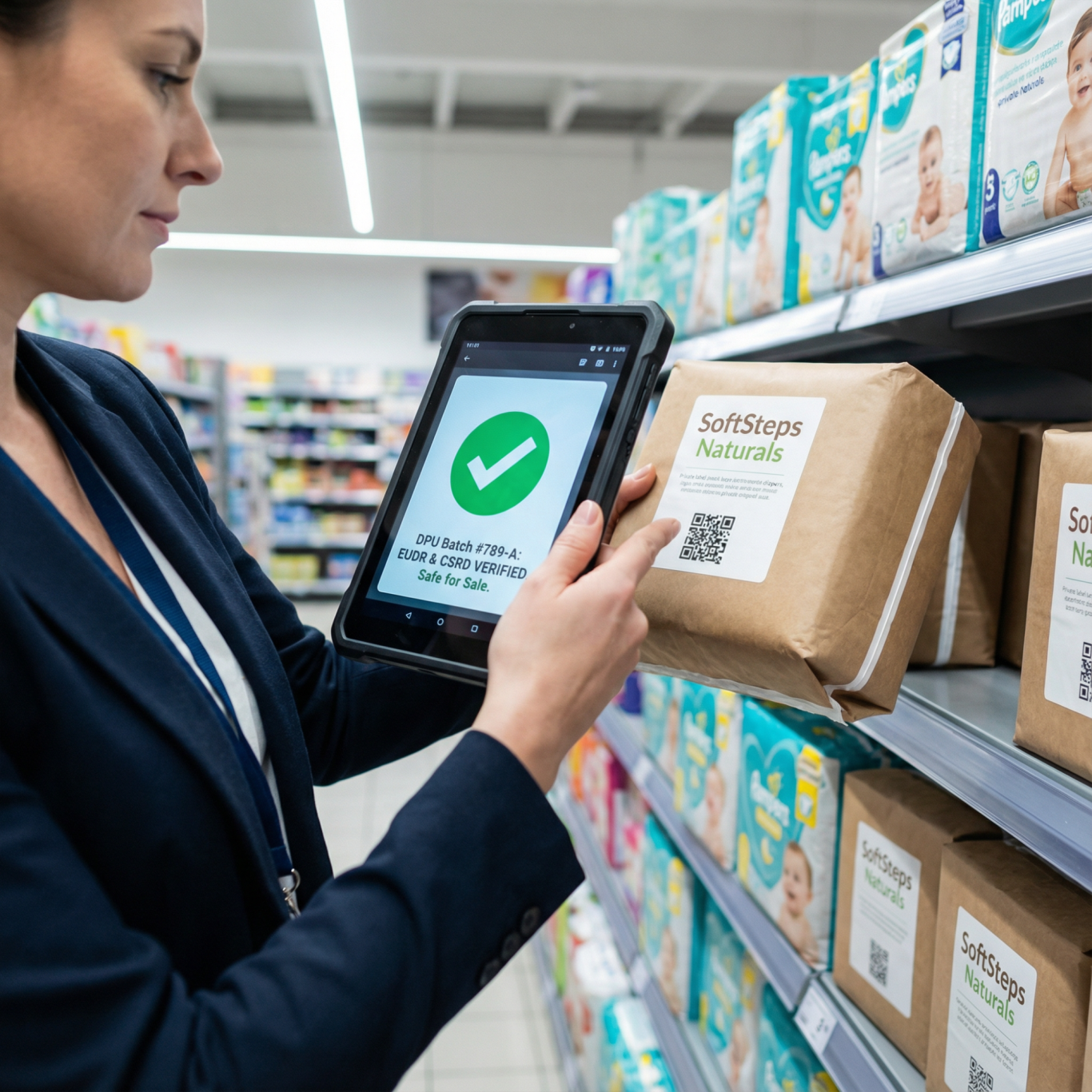
Storing full supply-chain data on-chain would be ruinously expensive. By anchoring only hashes, IoS reduces ledger costs to pennies per proof instead of millions per year. That cost structure is what enables the quarter-penny DPU pricing and the entire pay-as-you-go model: the infrastructure itself is economically compatible with low-margin, high-volume CPG categories.
€19.7B
Europe ESG & Sustainability advisory market
55,000
European companies
29%
ESG reporting CAGR

Privacy: Proof Without Exposure
Most companies cannot, and should not, expose supplier rosters, pricing agreements, recipes, or proprietary process data to a public or shared ledger.
The IoS design ensures that IP never leaves the customer’s secure cloud; only the verification hash is shared. Regulators and counterparties can trust that a DPU is real and untampered without seeing anything commercially sensitive.
Compliance becomes provable without becoming transparent in the wrong ways.
Interoperability: Plugging Into Existing Stacks
The IoS does not attempt to replace ERP, PLM, LIMS, or MES systems. Instead, it plugs into them through connectors and APIs, ingesting events and emitting DPUs.
That design makes it compatible with SAP, Microsoft, Oracle, and other enterprise platforms while avoiding lock-in.
Customers keep their existing operational stack; the IoS simply adds a verification fabric on top of it


Assurance-Ready Data, Not “Blockchain Theatre”
Many early “ESG blockchain” projects failed because they produced technically sophisticated chains that auditors couldn’t actually use.
IoS flips that script: the focus is on generating clean, consistent, structured records that map directly to audit requirements, with the ledger used as an integrity layer, not a gimmick.
The goal is simple: when an auditor opens a DPU file, they see exactly what they need, in the structure they expect, backed by cryptographic guarantees.
A De Facto Standard for High-Risk Categories
By focusing first on high-risk, high-volume categories—like pulp-linked hygiene products, forestry-derived packaging, and similar sectors—the IoS is positioned to become the de facto digital standard in the spaces where regulators, retailers, and NGOs are looking most closely.
As adoption grows, DPU schemas and processes can be extended horizontally, but the core remains: a hash-anchored, regulator-aligned proof system proven in the hardest arenas first.