
Strategic Value Proposition: ROI & Risk Defense as the Core Product
The Internet of Sustainability is not positioned as “sustainability tooling”. It is sold as operational continuity and financial access. For every stakeholder—banks, retailers, manufacturers, regulators, consumers—the value proposition is framed in terms of reduced risk, unlocked capital, and measurable financial upside, not ESG theatre
For Banks & Lenders: Live Collateral, Not Self-Reported PDFs
IoS replaces annual, self-reported ESG decks with real-time, non-editable DPU streams. Lenders gain a continuously updated view of collateral integrity: batch-level, SKU-level, region-level.
This enables Sustainability-Linked Loans (SLLs) whose triggers are based on live, machine-generated evidence rather than static reports. Credit risk falls, monitoring improves, and ESG-linked margins become defensible rather than purely reputational
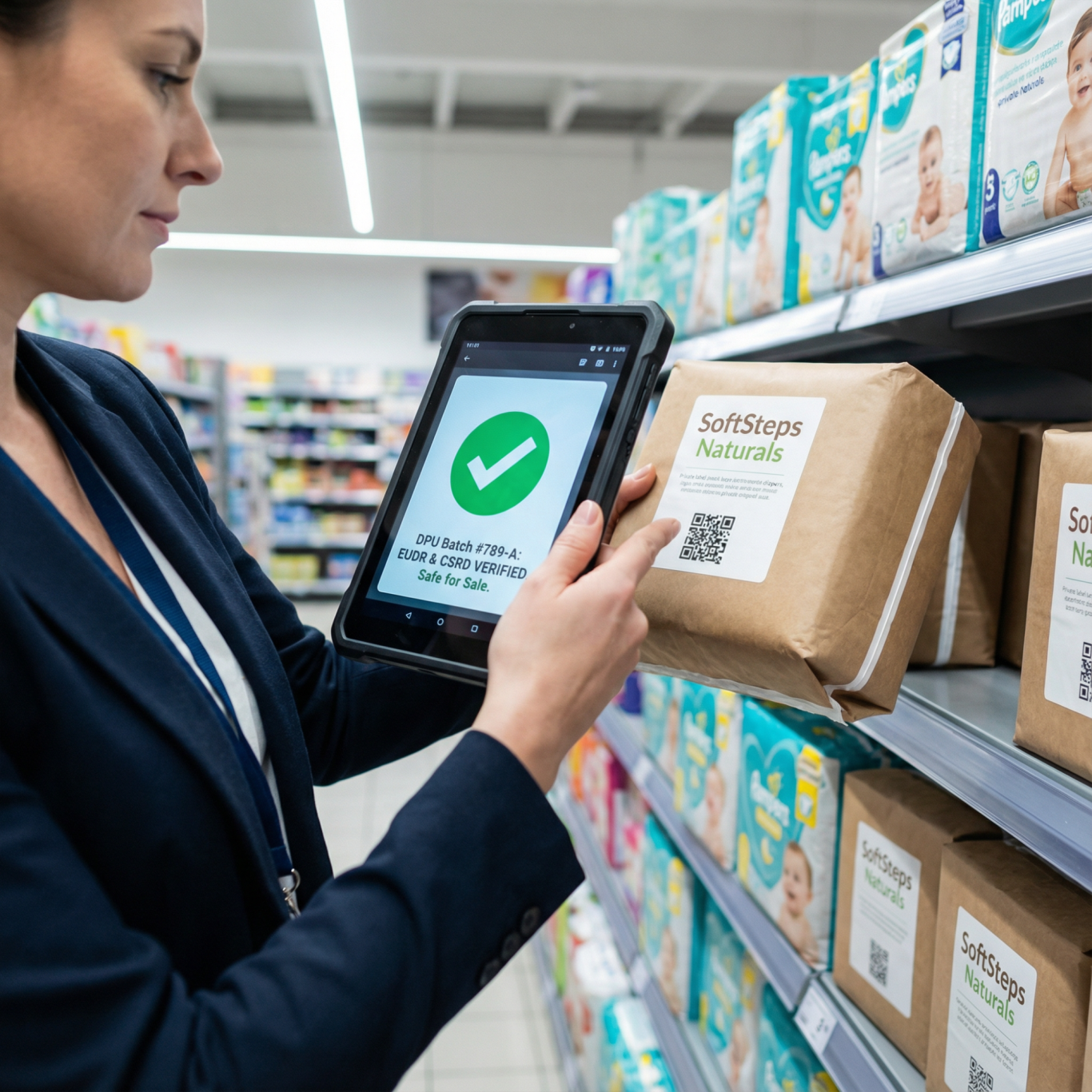
For Retailers: Shelf-Level Legal Protection
Retailers carrying tens of thousands of SKUs cannot manually police every ESG claim. With IoS, a retailer can demand DPU-backed proof for high-risk categories like diapers, textiles, and forestry-linked goods. Batch-level records reduce exposure to Green Claims litigation, EUDR seizures, non-compliant supplier risk, and Scope 3 misstatements. In practice, that means fewer recalls, fewer legal shocks, and a cleaner, defensible ESG story at the shelf.
€19.7B
Europe ESG & Sustainability advisory market
55,000
European companies
29%
ESG reporting CAGR

For Manufacturers & OEM-Cs: License to Operate
For OEM-Cs and converters, adopting IoS is equivalent to buying a “license to operate in the EU” without hiring a compliance department.
They get instant EUDR/CSRD-aligned proof, no €1M capex project, no multi-year IT build, and no dependence on consultants. IoS shields them from traceability failures and turns ESG compliance from a constant firefight into a predictable, per-unit cost of goods.
For Regulators: Verifiable, Machine-Readable Evidence
Regulators don’t want more PowerPoints; they want structured, machine-readable evidence. IoS gives them exactly that: DPU payloads mapped to regulatory schemas, anchored to an immutable ledger, accessible via standardized interfaces.
Enforcement becomes data-driven: faster checks, clearer flags, and less reliance on voluntary cooperation. The result is a regulatory regime that finally has the tools to match its ambition.


For Consumers & Brands: Trust Without Storytelling
Consumers are increasingly skeptical of generic eco-labels. A DPU-backed QR code lets them verify claims without reading a white paper.
For brands, this means they can shift from storytelling to proof, and use IoS as the independent backbone that underpins their claims.
The brand benefit is not another green logo; it’s the ability to say, “Scan this—and see exactly what we’re claiming, verified by an independent digital infrastructure layer”.
The Metric Layer: What “Good” Looks Like
A live IoS deployment can be read in clean metrics:
- Compliance coverage: % of units with active DPUs.
- Audit-readiness: Number of batches with fully anchored proofs.
- Deforestation risk: Reduced to zero where tree-free or verified inputs are used.
- ESG overhead: Reduced versus legacy audit/consultant baselines.
- Financing impact: Improved SLL terms, lower ESG risk premia.
These are the numbers that turn ESG from a narrative risk into a measurable, bankable advantage